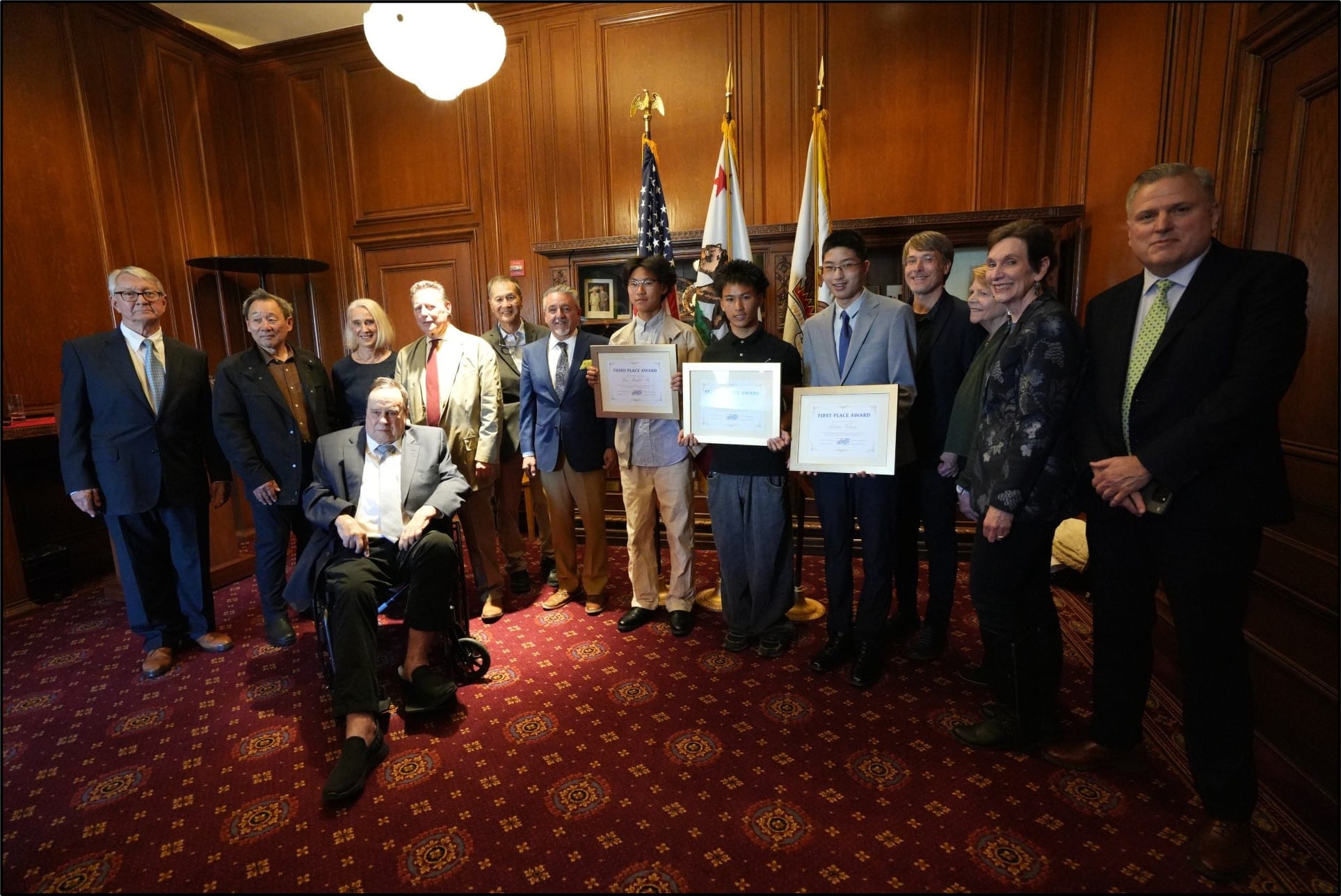
The winners of the seventh annual Charles Fracchia Prize competition for San Francisco high school students were announced on May 26. San Francisco Mayor Daniel Lurie congratulated the winners during a ceremony held at City Hall. This year, we saw impressive participation, with 110 submissions from 15 high schools. The writing challenge required students to research and write about an individual or group that helped make San Francisco a better, fairer, and more inclusive city by fighting injustice. San Francisco City Guides proudly co-sponsors the cash awards along with the San Francisco Historical Society. Congratulations to all the finalists!
First Place: Liam Chen, Lick-Wilmerding High School, 11th Grade
TOPIC: “Wong Kim Ark, Unsung Hero.” Liam’s essay tells the story of Wong Kim Ark, a San Francisco-born child of Chinese immigrants who fought the American government for his own birthright citizenship, which the government refused to acknowledge. This essay highlights the importance of the 14th Amendment and the ongoing struggle to protect the rights afforded to all citizens in the U.S. Constitution.
Second-Place Winner: Marc Chiu, George Washington High School, 11th Grade
TOPIC: “The Cost of Accountability: Barry Fong-Torres and the Fight for San Francisco’s Chinatown”
Marc wrote about one man’s fight to address gang violence in Chinatown in the 1960s and 1970s, a growing crisis that community leaders and elected officials alike had chosen to ignore. Fong-Torres accomplished this by building direct relationships with the teenage boys the Tongs were recruiting as gang members and showing them another way. Tragically, Fong-Torres paid the ultimate price for his work.
Third-Place Winner: Keo Bahk-Pi, Lowell High School, 9th Grade
TOPIC: “James Hirabayashi: An Unlikely Champion of Racial Justice”
Keo wrote about James Hirabayashi, a Japanese American professor of anthropology at San Francisco State, who faced a difficult choice: between the safety of his placid assimilation into American culture and the risks of opposing the rampant racial injustice permeating universities during the 1960s. Hirabayashi chose the latter, leaving a legacy that lives on to this day.